Categories
Uncategorized

Apur Sansar…..The World Of Apu

Friends, I hope with my blogs ” The beauty of Satyajit Ray movies” and ”Aparajito The Unvanquished” I am able to give you a fair idea about Mr Satyajit Ray and his movies. Most importantly I hope, that like me you all must have become fond of Apu. Apu is not just a character but a reflection of a journey called life.

Apur Sansar (The World Of Apu) is the last and the most intriguing movie of the Apu trilogy. Unlike the earlier movies of this trilogy, this movie completely revolves around Apu and his journey. In Aparajito we have seen that Apu is convinced by his grandfather to take up priests job after his mother’s death. Apu, having other plans refuses to do so and returns to Kolkata to pursue his education. In Apur Sansar we see Apu as a grown-up adult portrayed beautifully by Mr Soumitra Chatterjee. Apu being qualified bachelor is now in search of a job to meet his ends. In one of the scenes when his landlord pesters him for rent, Apu gives him a dose of his own medicine. Although not very impressed by this ,the landlord reminds him that if things don’t improve then he has to look for another tenant. While leaving he also reminds Apu about efficiently using the resources mainly electricity. The scene is so well shot that we all go down the memory lane of our bachelor days and recollect the epic conversations that we used to have with landlords.

Apu’s job search continues and he finds himself in a difficult situation as he is either overqualified or under-qualified for them. One fine day, he is visited by a college friend Pulu. Pulu takes him for dinner where he comes to know about Apu’s situation. After the dinner when Apu and Pulu go for a stroll, Apu tells Pulu that he as been writing a novel where the character’s journey is similar to that of Apu. Hats off to the Mr Satyajit Ray for articulating the dialogues between two friends and bringing alive friendship on screen where Apu pours his heart out to Pulu. Apu is animated and tells Pulu that although his struggle for securing a job is on, he is contemplating a novel. Pulu is excited about this and wishes to read it. Reminds us all about that one friend with whom we can share everything without hesitation. The one who will always stand by us come what may. At the end of their meet Apu is invited by Pulu for his cousin’s wedding which is planned in scenic countryside. Little does Apu know that this will change the course of his entire life.

Apu and Pulu arrive at the wedding location and during their journey, Pulu gets a glimpse of Apu’s writing which makes him more fond of Apu. For Pulu, its more of Apu’s autobiography but for Apu its his dream novel. He tells Pulu that though the character in his novel has been through crisis situations but that hasn’t changed his viewpoint about life and he still hopes for the best.

While Apu is enjoying the serenity of this place, a crisis situation arises and Pulu runs to Apu for help. The groom who was to marry Pulu’s cousin is found to be mentally unstable and the marriage is called off. To avoid bad omen, Pulu asks Apu to marry his cousin as a favour. After initial hesitation, Apu does agree and the marriage takes place. Let me now introduce Aparna who is Pulu’s cousin and now Apu’s wife. The character of Aparna is played by Sharmila Tagore when she was 15 years old. The innocence of Apu is so well portrayed on screen, his conversation with Aparna where he tries to comes to terms with this unexpected event of his life.

Apu and Aparna return to Kolkata after marriage and he tries to comfort Aparna in his bachelor residence. Now we all know how a bachelor residence is, in most of the cases it’s unorganised. To depict the differences between Apu’s bachelor days and post marriage, Mr Satayajit Ray uses his lens smartly to pin point few things such as the dirty or torn curtains getting replaced by new ones, new linens replacing old ones, the improvement in overall aesthetics of the room . Apu and Aparna’s chemistry is so beautifully depicted, be it Apu’s flirty eyes gazing at Aparna early morning, the smudged vermillion dot on Aparna’s forehead,all depicting the romantic moments of a newly wed couple. This is what you call a magical director who has displayed romantic intimacy without physical intimacy on screen.May be such great directors came from a different school of thought where emotions and feelings had a greater meaning.

Life moves forward for Apu and Aparna with Apu managing a clerk’s job and some part-time tutions. Soon they are overwhelmed with the joy of Aparna conceiving. Aparna leaves for her maternal home and Apu promises to visit her soon. Will this be Apu and Aparna’s last meet? In one of the scenes when Aparna us away at her maternal home, Apu is trying to go through Aparna’s letter secretly after office hours but is interrupted by his colleague. While travelling back home he again tries to go through the letter but a fellow passenger starts peeping making him uncomfortable. Apu reaches home and cannot hold his excitement to read Aparna’s letter. To his surprise he finds Aparna’s brother waiting at his doorstep. He breaks the most saddening news of his life that Aparna has passed away while giving birth to the son. What will Apu do now? Life has been posing challenges to him at every juncture. Will Apu survive this tragedy?

Apu is depressed after Aparna’s death and contemplates suicide but doesn’t commit. Apu doesn’t even go to meet his son as he considers him the reason for Aparna’s death. The director here tells us that even though we may face such extremities of life but giving up is not a solution. Negative thoughts might cross our mind in such cases but we definitely have more reasons to cherish life. Apu is a wanderer now and is more of a body without soul. Apu seems to be lost in this world and takes up odd jobs as he keeps shifting his location. He is so fed up that he tears away the pages which he had written for this novel. Apu’s friend Pulu comes looking for him and tries to convince him to take up his son’s responsibility. Apu’s doesn’t agree with him rather tells Pulu to make some arrangement for him. Apu assures him that he will take care of the money part but he his not ready to meet his son. Pulu refuses saying he is already tied up and cannot help him, with this Pulu leaves. Apu’s conscience is aroused and he finally decides to meet his son. His son’s name is ”Kajol”. In the meantime Kajol grows up under his maternal grandfathers watchful eyes. When we first see Kajol onscreen, we are reminded of our little Apu. One scene where kajol does some mischief and he is reprimanded ,he tells that his father will come and give them a good bashing. He is ridiculed saying that no one has seen his father’s tiki ( tuft of hair) for the last 5 years. Innocent Kajol asks, do fathers have tiki? A little boy who hasn’t seen his father since birth is simply drawing different images about his father. Craving of a child for parental love is conveyed through this single scene and beautifully portrayed.

Apu finally meets his son Kajol but doesn’t find acceptance from him. Apu tries hard to win over him but Kajol refuses to budge. Apu decides to leave and after walking a few steps he finds Kajol following him, he innocently asks Apu if he can take him to Kolkata to his father to which Apu agrees. He still doesn’t recognise Apu as his father but as a friend who will take him to his father. Apu is so moved by Kajol’s innocence that he realises how wrong he was to hold Kajol responsible for Aparna’s fate. He accepts Kajol and Apu’s journey continues.

With Apur Sansar and especially the concluding scene of the movie, Satyajit Ray gives beautiful ending or rather should I say new beginning or dimension to Apu’s life. Apu is not just a movie character. Apu is our reflection. Through this character , Satyajit Ray tells us, Life is 10% what happens to you and 90% how you respond.
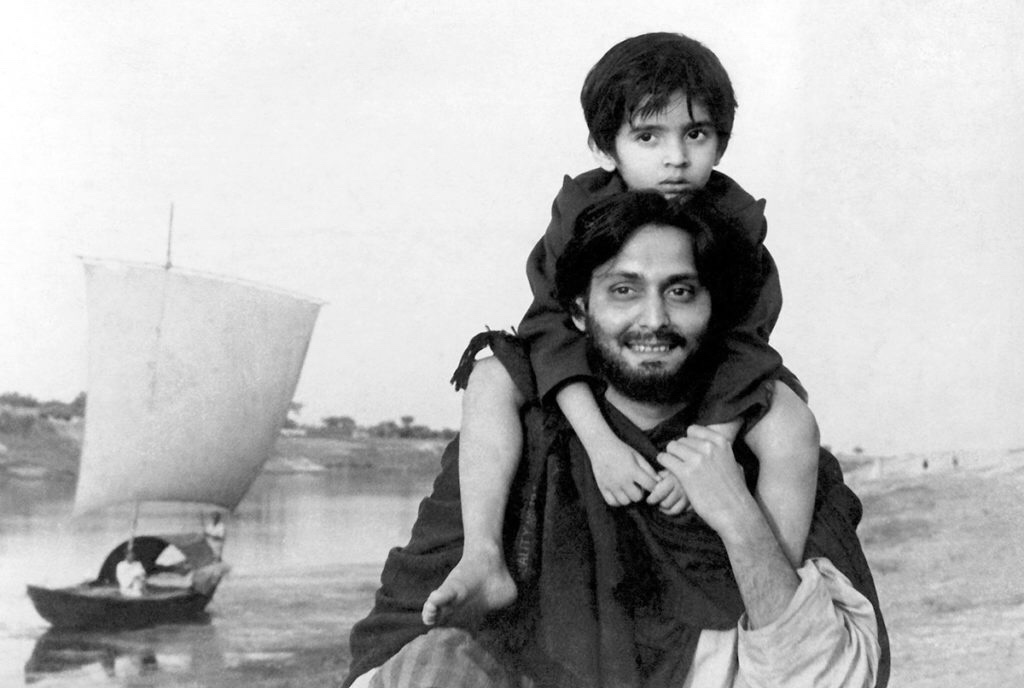
With this beautiful concluding scene from the movie I would like to quote Mr Robert Frost

But I have promises to keep, and miles to gobefore I sleep, and miles to go before I sleep. …

Categories
Uncategorized

Aparajito…. The unvanquished

In continuation to my earlier blog ”The beauty of Satyajit Ray movies” where I spoke of several Satyajit Ray movies and mainly about ”Pather Panchali”, today I would be sharing some of the beautiful aspects about ”Aparajito”. ”Aparajito is the sequel to ”Pather Panchali”.

Aparajito means unvanquished. I thought why such a title was selected for the movie. The very reason for the same you will get after you go through my blog. When I started watching Aparajito, I was a bit prejudiced and imagined that this movie will be hard-hitting and with a gruesome end giving a message that talent won’t get you anything unless you have the title. Here I have used the word title as a synonym for worth and position in society. However, while watching movies of such creative directors we should never be prejudiced that’s the lesson I learnt.

So coming to our characters Apu his father Harihar and mother Sarbajya, we had all seen that this family of 3 movies to Kashi after the untimely demise of Durga. The movie captures some beautiful landscapes of Kashi mainly the ghats of Kashi. Apu grows up playing in the lanes of Kashi, Sarbajya tries to adapt to this new place and Harihar steadies the ship of his family which slowly starts coming out of choppy waters. With things stabilising Apu’s parents start looking for a new house where school and market are nearby. Well, destiny has different plans for them. On the day of Diwali Harihar returns home heavily exhausted and with a high fever. Sarbajya gets worried about him however he assures her that there is nothing to worry about as overexertion has taken a toll him. Sarbajya tells Apu who is bursting crackers with his friends to accompany his father for some time till she gets some medicine for him. The conversation between a father-son duo can’t be simple and beautiful than this. Father being ill and down with fever asks his son with a smiling face about the crackers he has bought for Diwali, about his friends in Kashi. Something contradictory to what we have today, no time to speak to our parents, having a conversation is a remote scenario.

Next day Apu’s father thinks he has recovered and leaves for work with an unsteady gait movement leaving Sarbajya concerned. After a couple of hours, he is back home accompanied by 3-4 people as his health condition further deteriorates. He is treated and even after medication his condition doesn’t improve and Apu’s father passes away. Apu is hardly 7-8 years old now. What will Sarbajya do now? Will she be able to take care of our little Apu?

Let’s focus on Sarbajya whom we have seen more as a homemaker and as a simple character. In Aparajito Satyajit Ray explores the fighter in Sarbajya. Sarbajya may seem like a poor lady with a rural background, but she is, in fact, the iron lady of Aparajito. With Apu’s father passing away, Sarbajya tries to anchor her family by taking up a cook’s job. Apu accompanies her slowly becomes a part of that family where Sarbajya works as a cook by helping in some household chores. However one-day Sarbajya notices Apu doing something as a part of household work which is very incorrect at this age. She immediately leaves the job and moves back to her native with Apu. In such a situation where she is in dire need of money to take care of her family, how many would have taken this decision? Here the director wants to show us that Sarbajya even though being from a rural background is futuristic and has a vision for Apu. Moral over money is the message here.

Sarbajya is supported by her great uncle with a condition that Apu has to apprentice as a priest. Apu is young and he is coaxed into this to support his family. One fine day while returning home Apu comes across a few kids and he starts following them and reaches to the school in their village. He is excited about joining this school and convinces his mother to allow him to join. His mother finally agrees when Apu assures her that he will balance his apprenticeship as well as his studies. When someone has a thousand reasons to complain about fate ,here is our tender Apu setting his sail as per the wind.

Apu is a quick learner and is noticed by his headmaster and teachers when he gives some smart answers to an external authority who have come for an inspection. Impressed by this his headmaster motivates him to broaden his knowledge by sharing his books of varied subjects. Here the director wants to highlight that one should not be a kupamanduk (frog in the well) rather one should keep on broadening the knowledge base. Apu grows up learning new things, sometimes he is dressed like an African sometimes we see Apu applying some basic science principles in his house. Its all very nicely portrayed onscreen and tells us how we all can easily relate things we study with our surroundings. I wish I had this opportunity of having fun with science rather than mugging up textbooks. Out of all these, Apu makes a dial of the clock and locates it strategically such that based on the position of the sun he will come to know the approximate time. I was flabbergasted with rustic Apu’s zeal for scientific experiments. This clearly tells us all that it doesn’t matter what you have what matters is what you do with what you have.

Apu comes out with flying colours in his exams and his headmaster motivates him to go to Kolkata for further studies. Apu is excited about this new venture and discloses this to his mother. Sarbajya is not very supportive of this. Why would she? After so many years things have settled down for her. But as I have told earlier she is futuristic, so finally she agrees to Apu’s proposal. Again moral questions are raised here. Is Apu right in his choice or should he stay back in his native and continue as a priest? Is it fair on Apu’s part to leave his mother who has a sacrificed so much for him? Here both Sarabjya and Apu seem to be correct on their stand but I am biased for Apu because his rise has been like a Phoenix. My statements might appear a bit insensitive but I will always prefer talent and ambitions over emotions.

Apu moves to Kolkata and joins college along with a part-time job. Apu starts adapting to city life along with new friends classmates. At times it seems that Apu has started enjoying this new life. His mother on the other hand keeps thinking about Apu which slowly starts taking a toll on her health. Apu does visit her during his breaks but his stay is quite short which doesn’t go well with his mother. In one of the scenes when his mother requests him to extend his stay we see that Apu leaves for Kolkata but comes back from the railway station to her mother’s surprise. With this scene, it has been beautifully depicted that Apu might have grown up but he is still our Apu, the city life has not made him ruthless.

Sarbajya’s health starts deteriorating and she expects Apu to visit her once. However, Apu’s exams are on the cards and he plans to meet her after his exams. To his misfortune, when he receives the letter stating his mother’s illness and leaves for his native, he finds that his mother has passed away. What will Apu do now will he repent or will he drown in sorrow? Will Apu be able to overcome his mother’s death? I will not disclose the ending because it’s for you to watch out in the movie.

Satyajit Ray in most of his movies tells us that life is multi-faceted. What may be right for you may not be right for any other person but he doesn’t judge you rather he tries to bring everyone’s opinion on the table. He etches each and every character so perfectly that the movies are not just about protagonist and antagonist, they are character-based and every character is important. It’s like a puzzle and with one piece missing the picture will be incomplete. Satyajit Ray movies are about social issues, issues which were very much prevalent in those days. All his stories have a long-lasting impact on you as if they are constantly trying to mould you to be a better human being for this society.

In Aparajito even after so much turbulence in their lives, Apu and his family don’t give up. It might not be an outright victory for them in every situation but most important they don’t lose hope they don’t lose heart. So the title Aparajito meaning undefeated or unvanquished seems apt for this movie. The most important takeaway for me from his masterpieces is” Every ending has a new beginning”. So when things are not going the way we want, let’s look at it from a different lens, who knows it might a new beginning with new opportunities.

Categories
Uncategorized

The beauty of Satyajit Ray movies

Since the last few days, I have developed a keen interest in watching Bengali movies. It’s not about watching any Bengali movie but the ones directed by Mr Satyajit Ray. My association with Satyajit Ray movies started a couple of months back when I watched the movie ”Shakha Prosakha” After watching the movie I came across a few articles which stated that this movie was directed in the ’90s and is a part of the so-called trilogy which included Ganashatru and Agnatuk. Both of these movies were released around the same time. I watched Ganashatru and Agantuk both, but of all the three films I liked Agantuk the most. I was enthralled by Utpal Dutta’s performance in Agantuk. I have always cherished in fact enjoyed watching Utpal Dutta in movies like Golmaal or Naram Garam. Never had I thought that he was such a fantastic actor and he was not a stereotyped actor limited to comic roles but a matured and one of the finest actors of those times. His casting in Agantuk was perfect, his portrayal of that character in Agantuk is beyond words. Well let’s leave it for another day when we talk about Agnatuk and Mr Utpal Dutta.

After watching this trilogy, I started looking for more Satyajit Ray movies. I developed my own watchlist and I ended up watching some of the masterpieces such as ”Ghare Baire” ”Pratidwandi” ”Jana Aranya” ”Seemabaddha” ”Guphi Gayen Bagha Bayen” ”Hirak Rajar Deshe” ”Joy Baba Felunath”

As a Bengali, I feel embarrassed to admit that it took me 32 years of my life to come across such masterpieces by Mr Satyajit Ray. Nevertheless, I feel contented having watched these movies when I can relate with them. Although it’s my personal opinion , I firmly believe that we need maturity and intellect to understand and appreciate movies directed by Mr Stayajit Ray.

Having said about so many things I would like to bring your attention on the trilogy by Mr Satyajit Ray which I feel is eternal. Any guesses? I am talking about the Apu Trilogy starting with ” Pather Panchali” followed by ”Aparajito” and ”Apur Sansar”.

When I started watching Pather Panchali I developed an interest in its storyline and its characters. The story is about a poor Brahmin family where the head of the family Mr Harihar Roy is an educated Brahmin and is looking to meet ends for his family. His wife Sarbajya who tries to manage the family with her husband’s meagre income and also look after two beautiful and innocent kids ”Durga” and ” Apu”.The family of four seem to be contented and happy in their present situation. It’s very difficult to find out such a family nowadays. Well, I must not forget about one more character in the family ” pisima” that is Indir Thakrun. It’s difficult to describe pisima in words, it’s only when one watches the movie, one gets to know about this character and how Mr Satyajit Ray has searched for such a character and cast her in this role. Coming back to our main characters, the learned Brahmin Harihar is a free thinker. He feels that his education, his knowledge will be duly rewarded but the same doesn’t happen and soon he has to leave his native looking for a job to meet his families needs. Sarbajya his wife is always worried about her family and keeps on reminding her husband about the present situation and family requirements. She is like every other homemaker who wants to ensure security of her family along with a decent future for her kids.

Durga and Apu are the most beautiful and interesting part of this masterpiece as the story revolves around them. Their childhood and innocence have been so well captured on the screen that at any point of time you can not think of any other child actor/actress portraying the role of Apu or Durga even if a remake of this movie is thought about. I guess you all are aware that all characters of this movie were facing the camera for the first time and none of them was a seasoned actor or actress.

There are a number of scenes in the movie where I was left spellbound just by the simplicity with which the scene was portrayed on screen. I thought as if a bunch of actors were told to be themselves on the screen and the cameraman was capturing the perfect moments. I would like to share a few scenes with you which I liked the most. There is a scene in the movie where a sweet vendor comes to their village and Apu and Durga watch him hoping that they would convince their father for some money so as to buy some sweets. Even after a futile attempt of getting some money and buyingbsweets, they are not disappointed and decide to follow the sweet vendor and find their happiness in that. A subtle message for all of us that happiness is a perspective, you can always be happy if you want to be. Another scene where Apu in his pathshala plays tic tac toe on his slate when his teacher is giving some dictations in the class. Finally, when they are caught by the teacher and are punished we all are reminded that in our school days we all have done such kind of mischief and even we have been punished. All these things make us more fond of our childhood days making us nostalgic at times. One more scene I would like to share is when Apu and Durga while wandering in the fields looking for their cow come across the railway track. The joy on their faces of watching a train is priceless. Such is the beauty of childhood where everything is so exciting and life is simple. All such aspects of childhood have been captured amazingly by Mr Ray.

Relationship between siblings is another angle which has been depicted beautifully in this movie. For instance, when someone comes.to their house complaining about Durga, little Apu’s gestures to her sister for not entering in the house are worth a watch.

I have tried to pen down some of my favourite scenes of the movie Pather Panchali but it’s my sincere request to all of you to definitely watch this beautiful movie.

Life is a roller coaster ride, everything in life doesn’t happen as we expect. Life always has it’s own plan. As the story progresses we see that Harihar is out of town since months and has not communicated with his family. Sarbajya is trying to feed her kids by selling off whatever she has. At this juncture, they are struck with a tragedy. Durga falls sick with fever and in the absence of proper medical treatment, she succumbs to high fever. In the meantime when Durga is ill, Haraihar does write to her wife that he has got a source of income and even saved some money so he will be back soon. Although Harihar is late in this race against time and realises on reaching that his beloved daughter has passed away. That’s why I have mentioned earlier that life is a roller coaster ride, just when things had begun to settle for them, they were caught in an unexpected storm. After Durga’s death, there is a scene where Apu starts managing his daily activities on his own which earlier were supported by his mother or sister Durga indicating that Apu has matured at a very tender age due to family crisis.

What I liked about Satyajit Ray movies is that the characters are built up, the storyline takes a pace and suddenly when you least expect a twist or turn you are treated with one. But the beauty of twists or turns or tragedy in his movies is that through these scenes he will constantly ask questions and evaluate your conscience. It’s like you are given a situation and you have to act, your actions will decide the depth of your principles, morals , ethics, values.

After watching the movie I asked myself a few questions which I would like to ask you also. Was it important for Harihar to leave his family for earning money and let his family tide over the crisis all alone? Which is more important money or family or both are interdependent? Is it difficult to maintain a balance between family and one’s ambitions? Well many such questions arise in my mind but I don’t have answer for such subjective questions since these are situational.

Finally, Harihar moves to Kashi with his family to make a living. He has to move out of his ancestral house which he has tried to protect so long. Is there a message in this stating subtly that one has to cross boundaries and leave emotions behind if one wants to progress in life. For the young their progress and ambition may seem important but for the old it’s the emotions that matter. It’s a debatable point, which we can discuss in another blog.

When I started writing this blog I had planned to cover Aparajito and Apur Sansar so as to cover this trilogy in the same blog. But now I feel that all three movies deserve a separate blog and it would be injustice on my part to squeeze such masterclass in one blog.

This is the first blog I am writing. Hope you all will like this. Your comments are most welcome and keep reading for may such interesting blogs.

Design a site like this with WordPress.com
Get started